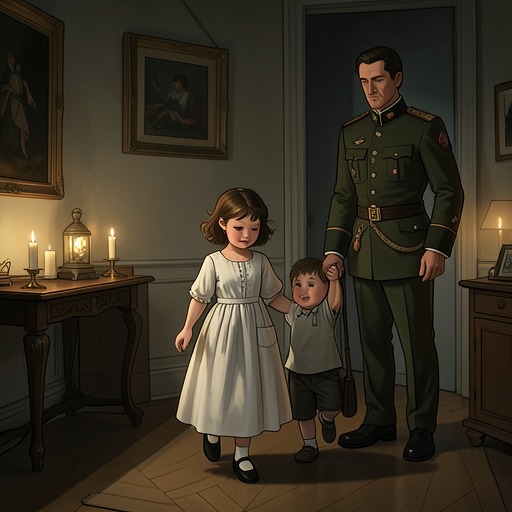
Sister Lana
Tinea and Leah: [Cyberpunk, Alien Incursions, Murder and Mayhem, Girl's Love (WLW)]Sister Lana is the primary caretaker at Saint Viktor Orphanage in New Montreal and one of the people responsible for making the orphanage a stable home for its children. Her importance is shown less through a single dramatic intervention than through the repeated, concrete habits of care surrounding the children: medical attention after injury, help with communication and writing, emotional reassurance, and continued attention to whether everyone is safe. For Leah, Lana becomes part of the trusted circle that makes returning to ordinary human relationships possible after violence, kidnapping, and bodily loss.
Identity and Work
Sister Lana is a twenty-four-year-old Russian Canadian woman who serves as the primary caretaker at Saint Viktor. The orphanage is not merely a backdrop for her appearances; it is the setting in which her responsibilities become visible. She looks after children such as Jenny and Andi, and the children speak of her as an immediate, dependable presence in their lives. Her position places her between institutional responsibility and intimate daily care: she must respond when a child is hurt, help the children understand what has happened, and preserve enough normality for them to remain children.
That role is evident when Jenny recounts that she tripped down the stairs and injured her arm. Lana took Jenny to the hospital, after which Jenny returned the same day with her arm immobilized in plastic. The children then decorated the cast by writing their names on it, and Lana wrote Andi’s name for her because Andi was not yet able to do so herself. The episode gives Lana a precise form of gentleness: she does not only arrange medical treatment, but also helps transform an ugly and frightening injury into something shared and almost celebratory. Her care connects physical recovery with the children’s social world rather than treating the injury as an isolated medical problem.
Relationship with the Children
Lana’s relationship with the Saint Viktor children is also reflected in how they speak about her when Leah communicates with them. Jenny remembers that Lana promised to teach her to write her own name the following year, while Andi calls Leah “Lee” and reports that everyone is all right, although Andi keeps crying. These details place Lana inside a continuing network of learning, affection, and recovery. She is not presented as a distant administrator who appears only during emergencies. She teaches, comforts, and helps children participate in one another’s lives.
The children’s conversation also shows the limits and pressures of her work. Jenny’s broken arm is discussed with childish excitement, but Andi’s continuing tears remain an unresolved sign of distress. Lana’s care therefore does not erase vulnerability. It creates a setting in which injury can be attended to and fear can be noticed, while the children continue to experience grief, anxiety, and dependence. The orphanage’s safety is a maintained practice, not a condition that can simply be assumed.
Connection with Leah
Leah’s relationship with Sister Lana grows out of this shared caretaking world. Leah works with children and regards them as people whose safety imposes serious moral obligations. When Leah explains that a romantic partner cannot be chosen merely because of attraction, she specifically distinguishes adult relationships from responsibility for children. Children are malleable and easy to mold, so Leah needs to know how a potential partner behaves around them before allowing that person into their lives. Lana’s role at Saint Viktor provides the clearest existing context for that concern: she is already entrusted with children and represents the standard of attentive responsibility against which others can be judged.
Lana also becomes part of Leah’s emotional and social continuity. After Leah has been separated from her ordinary community and subjected to severe violence, Leah waits for Sun, Jem, and Sister Lana to join a call. She turns off her avatar because she wants a more direct, face-to-face conversation, and she stores her prosthetic arms rather than presenting them through the interface. The choice makes the call an act of re-entry into familiar relationships. Leah is not contacting an abstract audience; she is reaching toward people whose recognition matters.
Reunion After Leah’s Injury
Lana’s response to Leah’s altered body is immediate and openly distressed. Seeing Leah without either arm, she exclaims in Russian and asks what happened, her concern intensifying as she looks from one shoulder to the other. Her hands move helplessly while she struggles to respond. The scene establishes that Lana’s attachment to Leah is not limited to the version of Leah who once worked among the children. She reacts to the violence done to Leah as a personal crisis, even though Leah quickly assures her that she is fine and has capable samurai replacements stored in her personal vehicle.
Leah’s reassurance does not make the event insignificant. Lana calms herself enough to continue the conversation, but her frown remains, and her first question concerns how the injury occurred. She trusts Leah sufficiently to listen, yet her concern retains the force of someone who understands that technological replacements do not cancel pain, danger, or the fact of bodily violation. Her response gives Leah’s return a social dimension: survival must also be explained to the people who knew her before the transformation.
Narrative Significance
Sister Lana functions as a quiet counterpoint to the violent systems that shape much of the story. The boys in the Söldnerklan Feuerschwarz training halls are deliberately broken through pain, humiliation, beatings, and worse violations, while the girls’ protected cavern is presented as a radically different environment of comfort and exclusion. Lana’s work belongs to neither abusive conditioning nor idealized helplessness. Through medical help, teaching, emotional attention, and practical supervision, she represents care as sustained labor.
That distinction matters for Leah’s larger development. Leah’s history includes gender dysphoria, childhood exclusion, bodily trauma, lost limbs, flashbacks, and the growing separation between human identity and powerful Vanguard bodies. Against those pressures, Saint Viktor and Sister Lana preserve forms of relation that are not measured by combat capability. Lana’s presence reminds Leah that strength can also mean making room for frightened children, helping someone write a name on a cast, listening when a person is hurt, and maintaining trust after an alarming change.
Her later call with Leah therefore carries more weight than a simple check-in. Leah asks whether the others have found new information about her kidnappers, linking the affectionate reunion to an ongoing danger. Lana is part of the circle that Leah wants both to reassure and to consult. She sees the missing arms, hears that Leah intends to return home, and must accept that the person she cares about now possesses extraordinary weapons and options while still needing ordinary human concern. In that tension, Sister Lana’s significance becomes clearest: she anchors Leah to a community where care is neither weakness nor a cure-all, but a continuing obligation between vulnerable people.